Home
Retirement sale – Full Business Project for Sale including Spitfire No 1 at £87,500 and No 2 Spitfire at £85,000.
(substantially less than cost)
All moulds and patterns and sculpture design rights for sale too. Offer invited c £240,000
(good for at least 50 sculptures)
Welcome to the Bronze
Spitfire Tribute site


History
In the late 1990s I ran a foundry and a talented sculptor knocked on my door with a handful of very detailed fine art bronze castings he had made and asked if I would be interested in retaining him for a personal project. After much discussion I retained him to create an accurate sculpture of a Spitfire MK 14c – and so the project started.
After almost two years the wax body was finished and the sculptor went aboard for a well deserved break. Unfortunately these were the hottest two weeks of the year and on his return the wax had entirely ‘wilted’ and lost all its form!
However, I had become determined to have a Spitfire cast in bronze. Another sculptor was retained but a fire in a foundry we’d planned to use put and end to that hope.
During the next 4 years the project went to 2 other studios associated with other foundries only for a succession of fire and flood providing ongoing setbacks!
It seemed at times that the project was doomed to never get off the ground…
But I was eventually introduced to the remarkable sculptor Stephen Allen.
About
After more than 25 years in design and development we are now able to share with the public the stunning beauty and world-class craftsmanship of our Spitfire Tribute Sculpture.
There will be just ten made available for the UK market and ten for the US and world markets.
Two more will be cast for museums – one on each side of the Atlantic. No more will be made.
Read more
These world-class, breathtaking Mk 14c Spitfire sculptures were modelled by the renowned sculptor Stephen Allen. Those already made were cast at the Bronze Age London foundry that has long been the preferred foundry of Royalty – including the late Majesty Queen Elizabeth II – and Heads of State. It produces what are arguably some of the finest bronze sculptures in the world today.
The Spitfire models weigh a quarter of a ton each – 230 kilos – and the wing span is 6.5 feet (two metres), and they are mounted on adjustable frames.
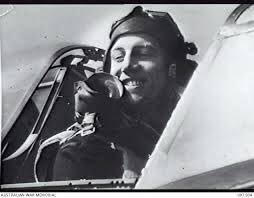
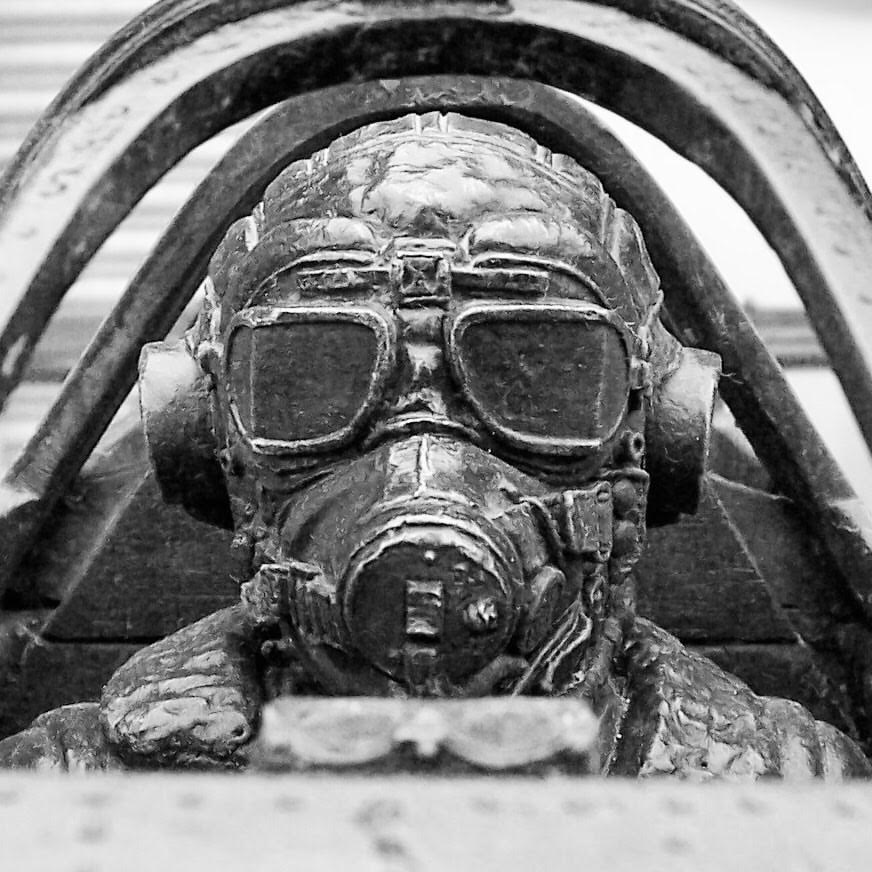
The patterns used have ensured fully accurate detailing of both the Spitfire body and the magnificence of the pilot – 22-year-old Flying Officer Ken Collier.
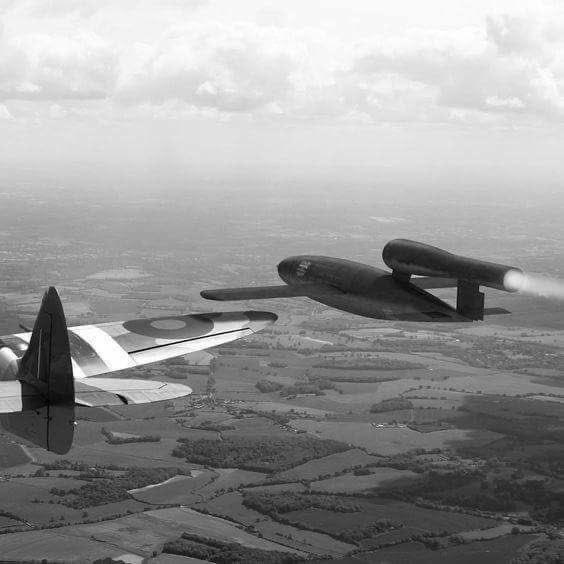
Collier is documented flying Spitfire RB188 in pursuit of many V1 flying bombs on their way to London, including one which was witnessed over the Channel and then picked up heading over Beachy Head in Sussex.
During his sadly brief flying career, Collier is recorded as intercepting and destroying seven V1s as well as being credited as the first pilot to ‘wingtip’ the bomb. This daring and dangerously brave manoeuvre involved nudging the V1 with a Spitfire wing to upset the bomb’s gyroscope, causing it to spin and crash.
Ken can be seen in stunning fine detail in the cockpit of the sculpture in his wrinkled leather flying jacket, well-worn gloves, leather flying helmet and goggles with two-piece glass (curved glass wasn’t made at this time!) as well as the detail of the instrumentation on the dash.
Each buyer will be able to select their preferred patina either through a visit to the foundry or from sample pieces of patinated bronze panels.
In addition to the 20 sculptures for sale, two will be produced for museums in the UK and USA. The public are invited to donate towards each museum piece to ensure that the tribute to such an amazing and brave young pilot and his Spitfire can be appreciated and publicly recognised.
Each donor will be invited to nominate their favourite museum and the two museums with the most votes will receive a Spitfire (donations must reach a pre-
determined amount).
Buyers will be allocated on a first come first served basis.


1944
Spitfire Mk X1Vc was manufactured in Eastleigh, Hants. It had enhanced performance to enable it to use the newer high-octane fuels which added to the speed and effective operating heights. This was essential for use in hunting and intercepting the V1 flying bombs en route to London.
The aircraft was numbered RB-188 and entered service with 91 Squadron based at West Malling Kent.
1998
The Spitfire Sculpture project was conceived and started.
FLYING OFFICER KEN COLLIER RAAF (1920-1944)
Kenneth Roy Collier was born in Glebe, an inner western suburb of Sydney, Australia, in 1920.
Read more
Serving with No 91 Squadron, RAF, Ken Collier was credited with devising a new method of destroying German V1 flying bombs targeted against England following the D Day landings. Fired from locations in France Belgium and the Netherlands, V-1s were the world’s first ‘cruise missiles’, and were intended as terror weapons directed primarily at London. During the first weeks of the German V1 campaign, the efforts of Allied pilots focused on shooting down the pulse-jet-powered missiles despite the difficulties of interception, as they crossed the English Channel at 560 kilometres per hour.
On 23 June 1944, after employing the conventional approach, of diving to catch and then shooting the missiles from behind, Collier had expended all his ammunition in the attempt, Collier resorted to moving alongside a flying bomb and positioning the wingtip of his Spitfire Mk XIV fighter below the missile’s stubby glideplane. He then banked steeply, flipping up the weapon’s wing so abruptly that he upset its automatic guidance system and caused it to spiral out of control into a field near East Grinstead.
Ken Collier’s technique was widely and successfully emulated by other pilots against the V-1 flying bombs.
Ken Collier was killed in an air combat engagement on the 5th December 1944, while flying a withdrawal bomber escort mission picking up returning aircraft from a raid on Hamm, Germany. A number of FW190 and Bf109 fighters were sighted and 91 Squadron aircraft made a diving attack out of the sun. Flying No. 4 in yellow section Collier was seen to enter the melee but did not return. Subsequent investigation discovered that his aircraft had been shot down by enemy fighters and his aircraft crashed near the village of Gelsenkirchen. Ken Collier is Buried in Rheinberg War Cemetery.
2007
Determination – The Sculptor
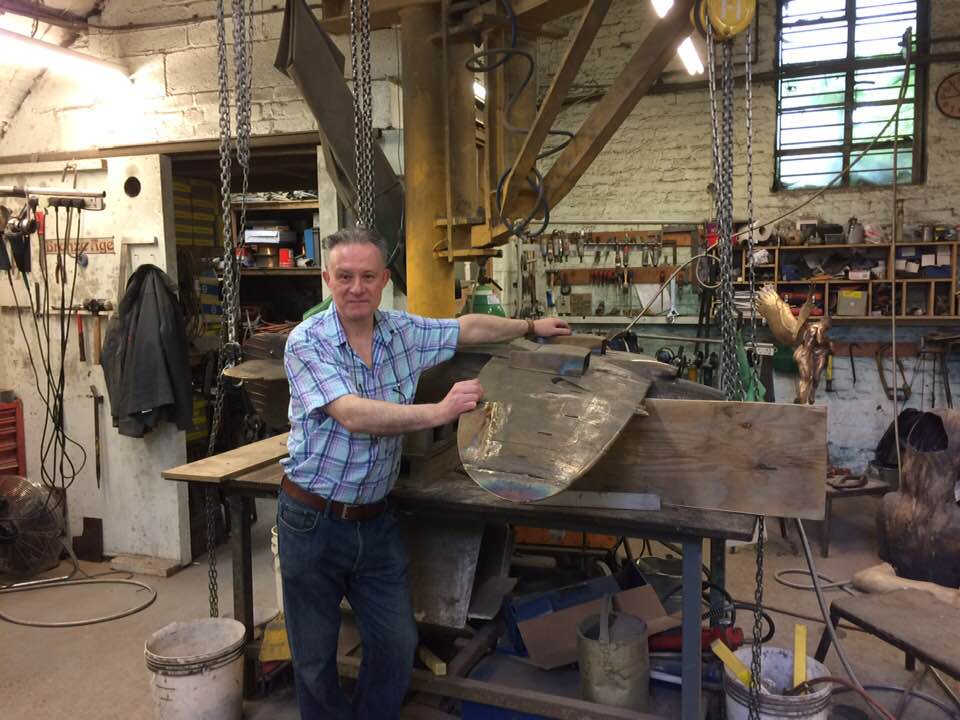
After setbacks of many years we were recommended to Stephen Allen*, a highly acclaimed and award-winning sculptor in Yorkshire. After much consideration Stephen agreed to take the project on. An initial assessment was made and much of the work was not accurate, with wing angles and relative dimensions incorrect. Stephen carried out extensive referencing on a Mk14c Spitfire and in essence suggested that we start from scratch. Along with many other recommendations we agreed to proceed and include a fully-detailed pilot and cockpit with unprecedented detailing.
Read more
Over a very lengthy period, the wax form took shape and when finally revealed the work was breathtaking. Every detail in the cockpit was visible, including all the dials on the dash, the wrinkles in the leather gloves and flying helmet and the joined flat glass in the pilot’s goggles.
*Stephen is an award-winning sculptor famous for his bronze of the Flying Scotsman. He has a great array of acclaim and awards and is a member of the Goldsmiths Guild of Craftsman and Design.
2011
After four sculptors, four foundries and three wrecked sets of patterns the first Spitfire No 1 was cast. All 39 pieces were cut, fettled, welded, hand finished and patinated.
The hand finishing was hugely time-consuming and after several weeks and hundreds of hours every fine detail was completed and checked by a team of skilled craftsmen.
The Stand and Mounting
The Spitfire is supplied with a crossed-base stand as standard.
Read more
The height is selected to allow the viewer to see into the cockpit and observe the incredible and intricate detail of the pilot and his cockpit. Beneath the Spitfire is a special adjustable mounting bracket, which allows the Spitfire to ‘fly’ at alternative angles.
Customers may of course want a bespoke mounting and adaptations can be made to accommodate their requests.
Patina
Each owner can select their preferred patinated finish. Almost anything can be selected in combination with polished highlights if required.
Read more
One sculpture is finished in an aged green patina with blended polished highlights including the wing’s leading edges and nose cone.
Buyers will be invited to the foundry to see and select their preferred option.
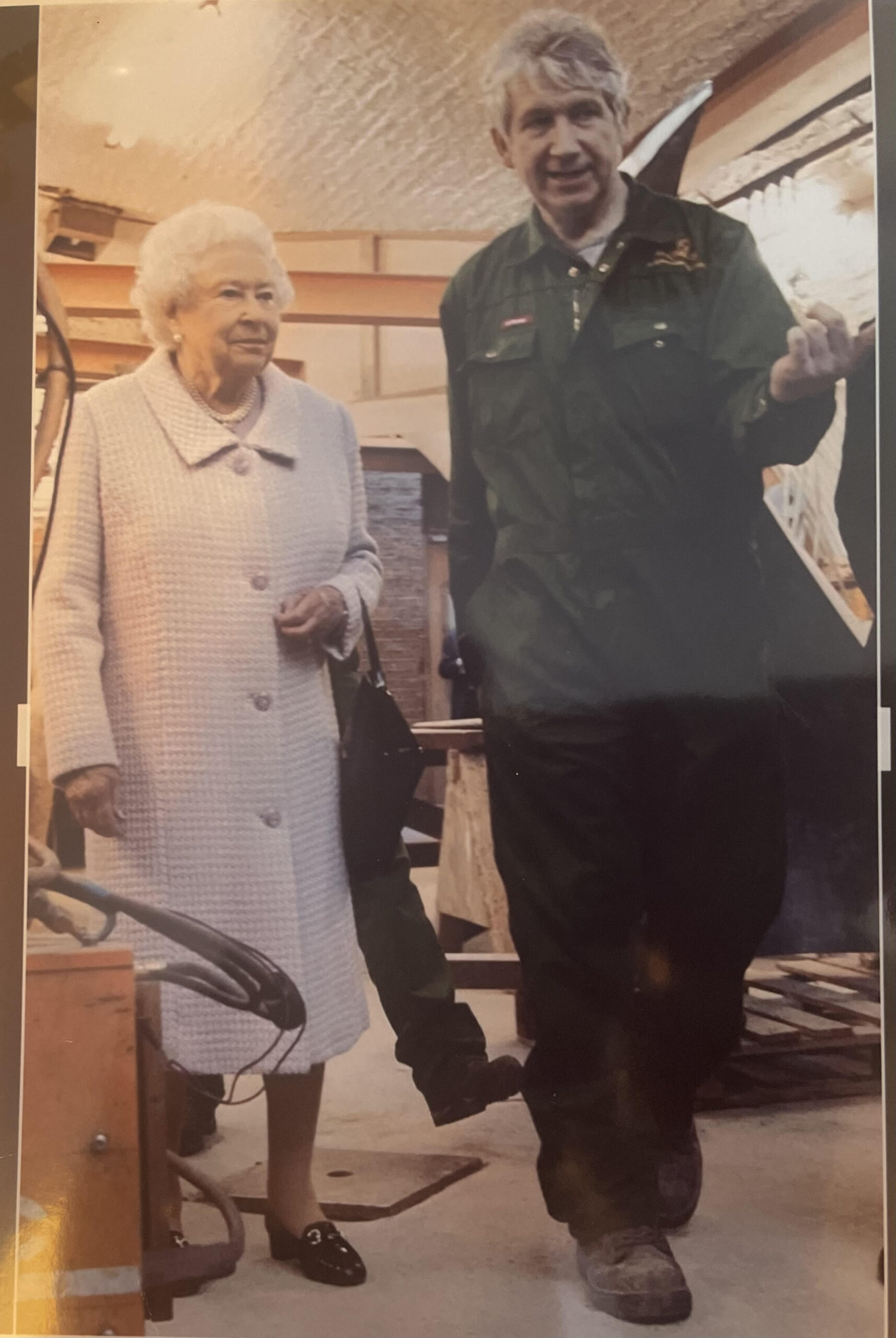
Bronze Age London foundry has a long history of making some of the most important private and public sculptures and, in 2022, was honoured by a visit from Her Late Majesty, Queen Elizabeth II.
2024
After a remarkably long story from the origination of the Spitfire Tribute Sculpture, with many ‘bumps’ and delays along the way, we decided to produce a very limited run of ten bronze Spitfires for the UK and the same number for the rest of the world.
We have decided to allocate one extra Spitfire each for museums in the UK and US. Whichever museums receives the most votes – on the basis of one vote for each £1/$1 donated on the crowdfund page – will receive the sculpture: here for the UK and here for the USA. (A minimum amount must be raised)
Where to See the Sculpture
Parties interested in buying a Spitfire can make arrangements to view No’s 1 and 2. Nr Eastbourne, East Sussex by emailing bronzespitfire@outlook.com.
To see the vast amount of work and read Flight Captain Ken Colliers story, you are invited to visit our fundraising page. Decide which of your favourite air museums you would like to see the sculpture in (one in the UK and one in the USA). You get one vote for every £1 or $1 donated.
At the conclusion of the fundraising, the top two museums with the most votes will each receive one of our wonderful Spitfires where they will be available for all to see (as long as a minimum amount is donated).
Donate
Gallery


